

The School of Knowledge is the weekly newsletter for SME owners and investors who want frameworks they can actually use — frameworks, checklists, and operating manuals every weekend, built to read on Sunday and use on Monday.
In the landmark book on cognitive science, Thinking Fast and Slow, Daniel Kahneman asked a simple question: can overconfident optimism be overcome by training? He didn’t think so. The main reason is that overconfidence in individuals is a feature of system 1 that can be tamed—but not gotten rid of. The main obstacle was that
subjective confidence is determined by the coherence of the story one has constructed, not by the quality and amount of the information that supports it.
Twenty-five very dangerous words.
Is he saying our brains, or rather—system 1—deliberately prefers quick, easy-to-digest, and familiar solutions over the quality of supporting information? If you take a second to think about that question before you answer (using your more deliberate and analytical system 2), you’ll likely come to the conclusion that you agree. To disagree would be to go against decades of cognitive science.
But Daniel Kahneman did acknowledge that where it is difficult for an individual to mitigate this lapse in judgement—Gary Klein‘s Premortem offered businesses and organisations an analytical framework that increased their ability to spot potential problems by up to 30%.
Premortem as risk diagnostic tool
When organisations and businesses make plans they’re usually optimistic, with risk analysis done as an afterthought: “we think this will work, but let’s consider some risks.” The problem with this type of thinking is that people stay overly optimistic, self-censor, and don’t want to seem negative—especially in group settings. The premortem takes a page from Charlie Munger‘s preference for inversion and starts at failure. When the plan is near being finalised, instead of identifying potential risks for the sake of it, Klein proposes to give a short speech that goes something like this: “It’s a year from now and the plan has miserably failed. What happened?” It shifts the thinking exercise from theoretical—to factual.
The premortem has two main advantages: 1) it goes some way to eliminating group think, and 2) it helps steer knowledgeable individuals in a much needed direction. Let’s go through the six-step process of how to conduct a premortem, including an example from my own business.
Brief the team just before commitment
Run the premortem when plans feel finished, but resources have not yet been allocated. Too soon and the plan won’t feel concrete enough. Too late and you’ll be battling with the Sunk Cost Fallacy. For my construction business, this could be at the end of finalising a tender—especially if the client is new, or if the tender sum is larger than our average bid. This shifts our thinking from “we need to start looking at our resources and capacity in the event that we win the tender” to “the job was a complete write-off and we need to desperately fix what’s happened.”
State the failure as fact
The statement of failure as a fact is critical. You’re not saying this might fail—you’re saying it has failed badly—and you want to know why. Ask each of the individuals to write down as many reasons they can think of for why it failed. It’s important that people know that nothing should be off the table in regards to why the failure has happened. It also shouldn’t feel, or be taken personally, with inflammatory language left out.
Everyone writes alone
No discussion. No group influence. Each person must generate their own opinions as to why the plan has failed. This is what separates the premortem from brainstorming and prevents the power of the first person’s words anchoring the group. If you need to, go in separate rooms. There’s always a cheater!
Round-robin: one reason per person per round
Each person takes it in turns to list one risk from their list. Have a facilitator note down all the risks and ensure nobody passes judgement as people are talking. This surfaces minority views that might not have had the opportunity in open discussion.
Group by failure type
Sort the reasons for failure into topics that best describe your situation. For example: execution failures (we didn’t do what we planned), assumption failures (our model of the world was wrong), external shocks (something happened we didn’t anticipate), and political failures (internal dynamics undermined the work). Pay attention to potential risks that have been flagged several times, cluster around a particular group type—such as execution—and especially reasons that leave the room in complete silence.
Amend the plan
For each high-priority failure reason, amend the plan, add a monitoring signal where possible, or explicitly accept the risk with your eyes wide open. Update, or create, your Risk Register for this plan, and add 3–5 concrete plan changes to mitigate those risks.
Why it works
Prospective hindsight lifts stated probability by 30%. I absolutely hate hindsight bias and it does something to my soul when people say “hindsight’s a wonderful thing.” Not least because it’s so obviously true, but because it doesn’t help you in any way at all. But Klein’s research found that imagining an event has already occurred makes people significantly better at identifying reasons it happened. Again, it’s important to reiterate: we’re not eliminating poor judgement, but limiting it. I’d take reducing poor decision-making by 30% any day—especially if all it took was a 10–20 minute exercise.
It gives permission to voice doubt without being disloyal. In most teams, raising concerns about a plan reads as opposition or negativity. The premortem reframes it as a contribution—you’re helping explain a failure that’s already happened, not undermining a decision being made. Risk management consultants get paid small fortunes from large corporations, organisations, and governments to remove risk—especially risk that comes with large financial implications.
It surfaces Unknown Knowns—tacit doubts that exist but aren’t spoken. The engineer who privately worries about a technical assumption, the salesperson who knows a client relationship is more fragile than the CRM shows—the premortem creates the structural conditions for those people to speak. It is specifically designed to surface quadrant III—unknown knowns. It can’t find quadrant IV (unknown unknowns, by definition), but it is extremely good at finding things the team collectively knows but hasn’t said aloud. Which is usually where the real risk lives.
How to run a Premortem in Claude
As part of my paid membership offering, where possible, I turn the mental models, concepts, and frameworks we learn into playbooks, article series, PDFs, worksheets, and other tools for practical people to deploy. For the premortem, I’ve created a generator whereby you plug in your project plan or decision and it conducts a premortem analysis for you—highlighting the six main risks in ranked order, proposals to mitigate them, and a revised plan you can print or download as a PDF.
Below, I used the premortem to better understand the risks of tendering for a project that is equal to 60% of last year’s revenue.
*Project or decision: tendering for a project that’s equivalent to 60% of last year’s revenue.
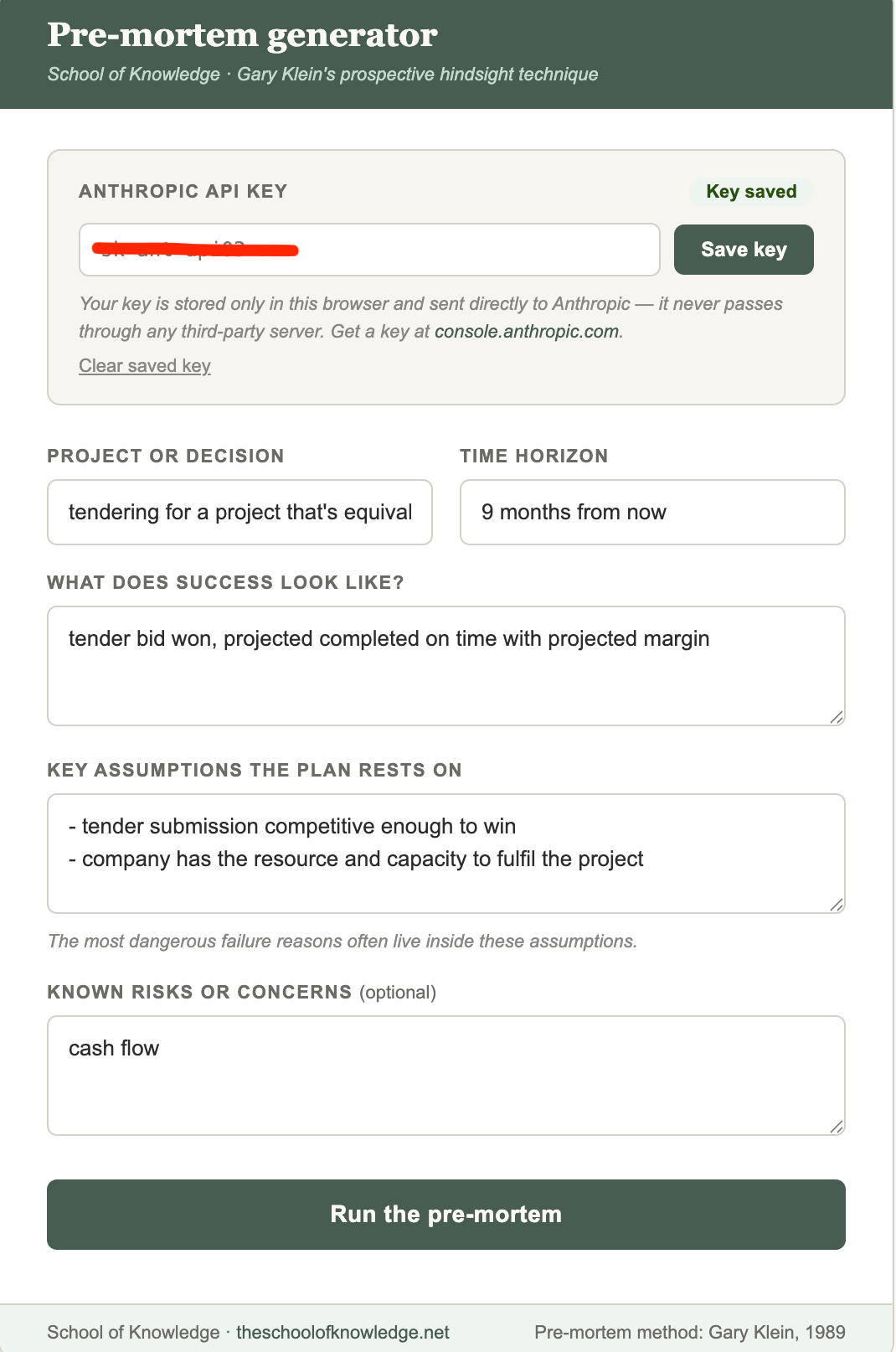
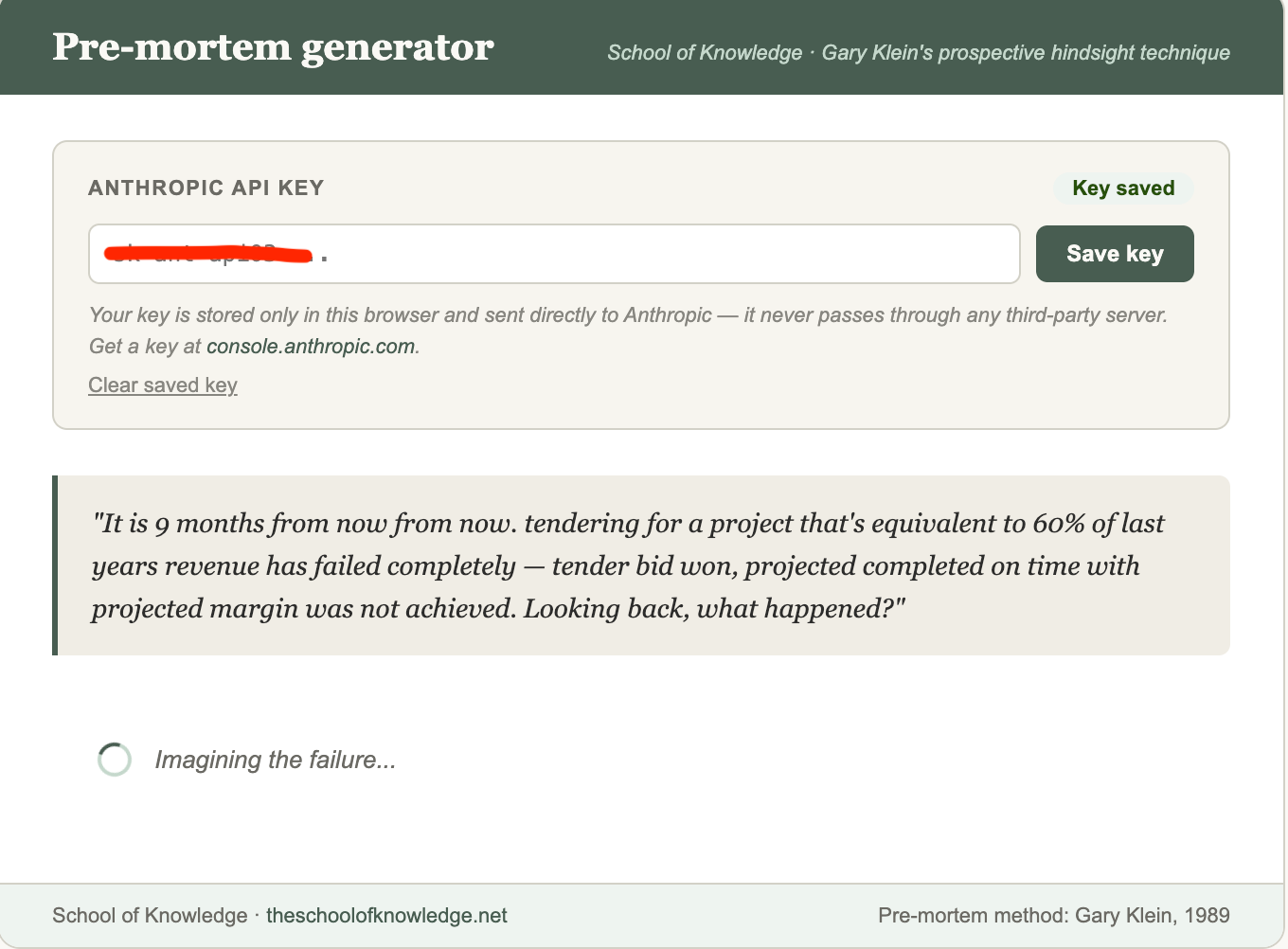
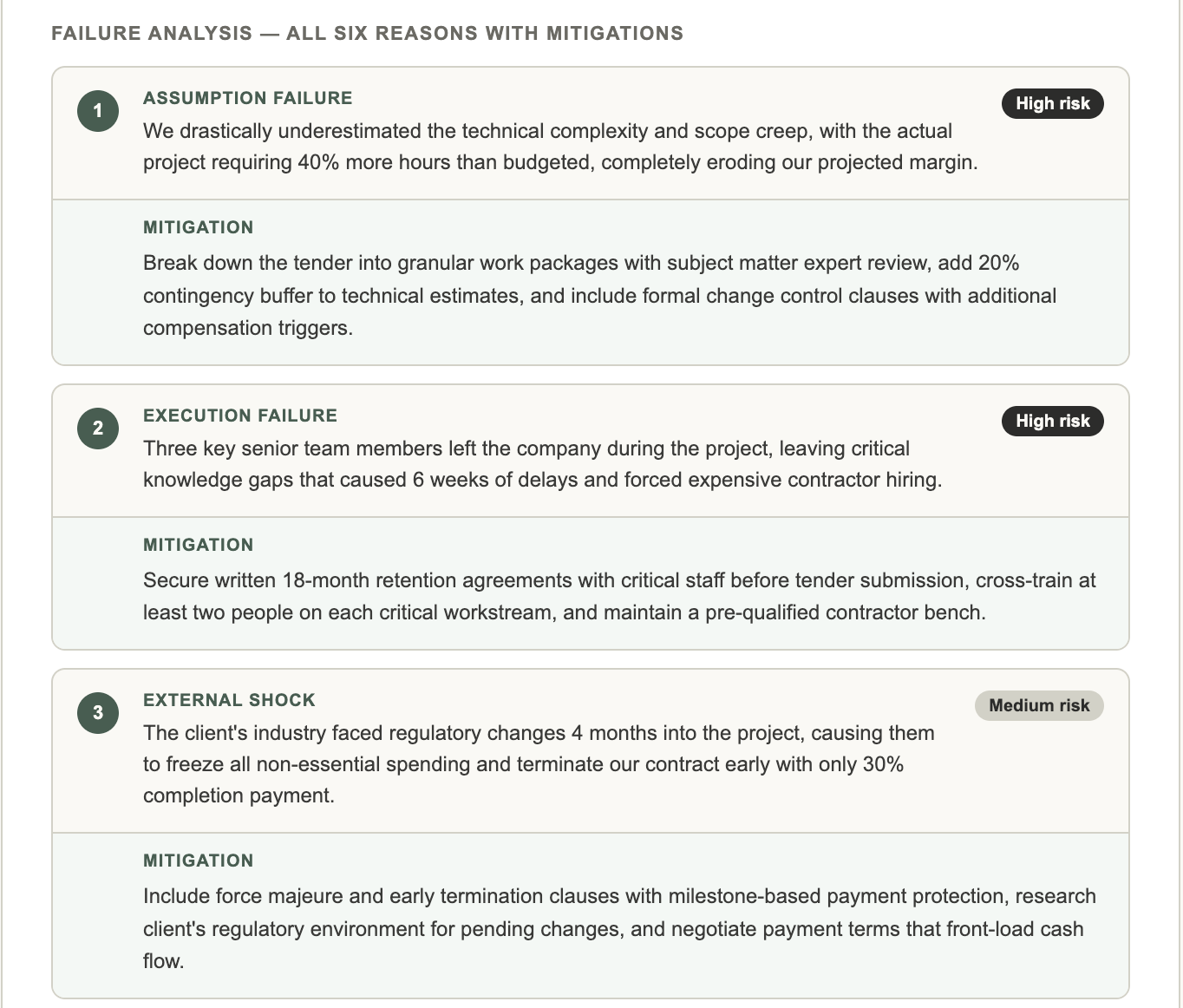
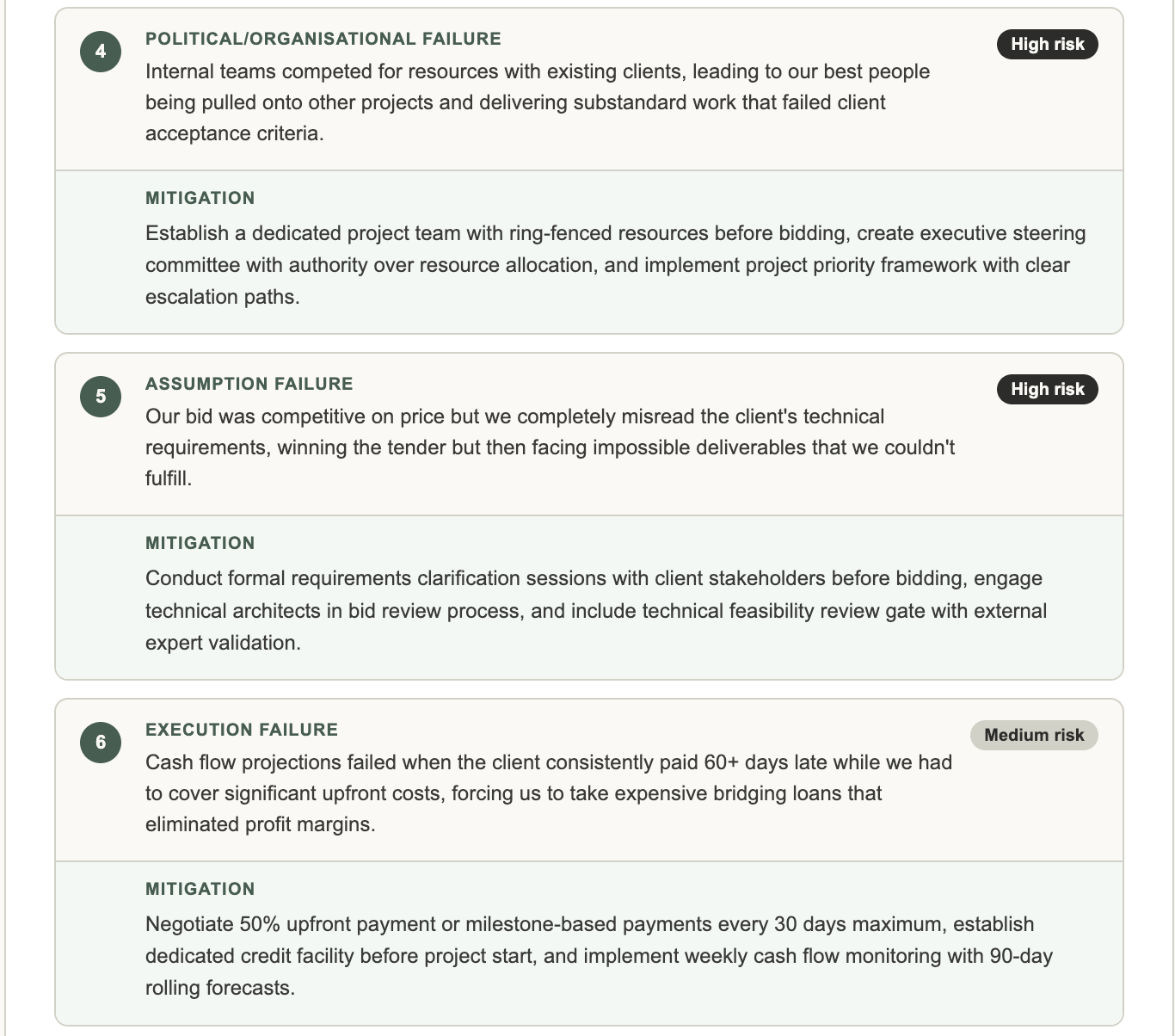
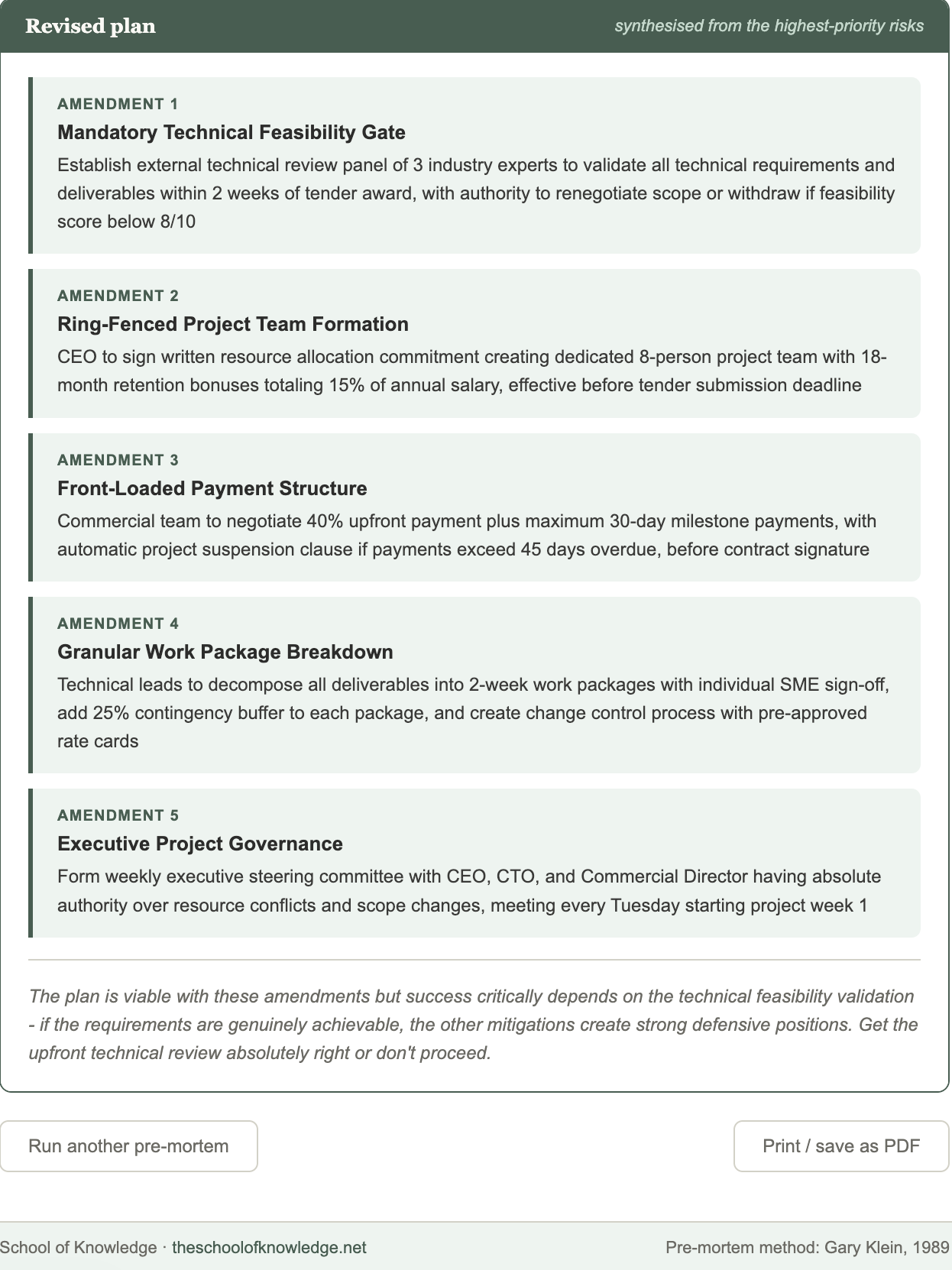
The Premortem as a risk mitigation framework excels because it draws on multiple knowledgeable people’s expertise—but for decisions you have to make alone, or if you want a quick analysis, the generator works great.
The concept and framework provided are free for all subscribers, but the tool is for paid members of the community which you can access below via the link.
