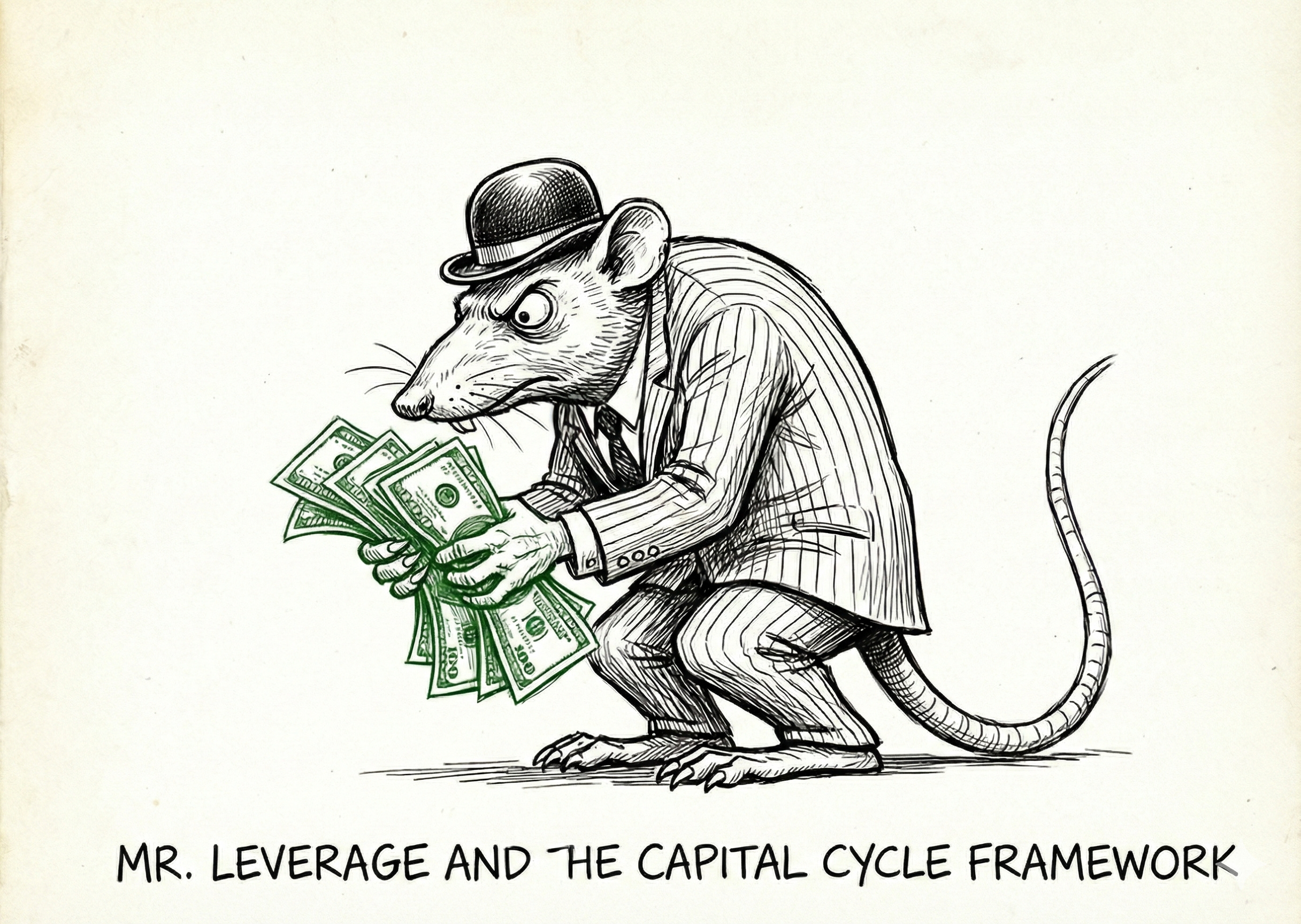
Why Great Returns Attract Terrible Capital
A parable about market cycles, vulture investors, and the holiday armadillo
Shepsi Max are in the beverage industry, which has been run by two big companies for generations. The returns are predictable, stable, safe. But, CEO Mr J. Skellington sits down one early November evening to watch TV, and sees an advert that makes him choke on his food.
A big, white-bearded fat man (Santa) is riding around in big red trucks, delivering Christmas presents and drinking his competitor drink! Even worse, he finds himself unable to get their catchy Christmas slogan of “The Holidays are Coming” out of his head. Gulp.
The advert is the talk of the town, and he soon sees more and more people drinking Koka Kola’s drink. This can’t be good for business.
Koka Kola’s profit margins start to rocket.
Scared of being left behind, he scrambles out of his chair and into the office, where he calls everyone into a meeting—a real all-hands-on-deck moment.
“I want a fatter Santa,” he screams at staff. “Bigger trucks and bigger presents,” he says, breathless. And finally, “Find out what they spent, and triple it,” as he collapses into his chair like a worn-out slinky. The team work around the clock for a week, but they have their advert and their own catchy phrase: “The Holidays are here!”
The advert’s a blast; profits rocket too.
It’s been two Christmases, two rounds of adverts, and the big two companies in the beverage industry are booming better than ever. Everywhere you look there are small cans of refreshing drinks. Up and up those profits climb.
Content, one sunny March morning, Mr Skellington is sitting in his office looking out of his large window when the phone rings:
“Hello Mr Skellington, it’s Frank Leverage here from Iron Bank. We love the adverts, and I’d like to talk to you about investing in your company.”
Vultures swarm over dead carcasses; investors on profits, but Mr Skellington wasn’t done feasting on profits just yet. He accepts their offer. This is too good an opportunity—how could I say no when my adverts are killing it?
A month later, as he’s eating egg soldiers for breakfast, he sees a new advert from his competitor. “But it’s Easter,” he says, exasperated. “I didn’t know we do them at Easter now?” As it turns out, Mr Leverage from Iron Bank had gone to Koka Kola as well.
Soon they’re both pumping out adverts for just about every holiday imaginable. Tired from the tit-for-tat behaviour, he sits down to watch the FIFA World Cup when he sees an advert at the opening ceremony. The newcomer’s called “Leverage,” and it all begins to click when he sees their catchy slogan: ‘Leverage takes you places you can’t go without it.’
Those fucking vultures.
More and more competitors enter the market, and more and more capital is needed to make bigger, better, faster adverts. With the Christmas period just around the corner, Shepsi Max need to pull something out of the stocking.
Back at his office, he calls an advertising meeting where a spotty 17-year-old apprentice (who he can’t remember inviting to the meeting) whips out her $2,000 smartphone and shows him an idea she’s been working on. There’s a new Christmas hero in town this year; ‘The Holiday Armadillo,’ and he’s dying to get his claws on our tasty beverage.
This looks good. She’s done a good job of making the can look so refreshing. “The armadillo is so scaly and rough; how did you do this?”
“It’s AI,” she says.
Mr Skellington sits this wise 17-year-old down and talks to her for several hours straight about their new edge—AI. He surmises that AI can drive down production time, speed up productivity and, after an initial capital outlay, lower costs. This is the edge he’s been looking for. It’s finally time to be number one.
The company is soon hiring more engineers, designers and technology experts who seem to be more focused on the production of AI-generated videos than the production of small tasty beverages.
Except, the holiday armadillo advert wasn’t a blast, and there are now adverts on every TV, billboard and smart device across the country.
The sinking realisation suddenly hits him—the big two no longer have a monopoly on tasty over-sugared drinks. The market’s flooded with adverts a kid with a phone can make, and soon the profits start to erode, just like the teeth of all the little kids who drink their drinks.
Mr Leverage and men in pin-striped suits (who look like they’re going to rob him at any minute) are waiting for Mr Skellington outside his office the morning after their “disappointing” results were published.
“Did you think you could get away with a 19% return on invested capital? Last year it was 20%, for God’s sake!” Mr Leverage said angrily.
The men in pin-striped suits said nothing.
The angry men told Mr Skellington they were taking their capital and going elsewhere after he had let them down so much. A $1.9 million return on their $10 million investment only a year earlier is “the laugh of Wall Street,” they tell him.
Ashamed, Mr Skellington is driving home when he receives a call from long-time but friendly competitor Frank, of Koka Kola. “My company’s done, Nick. It’s over. They’re taking their capital elsewhere, and my stock’s down 40% after we missed our quarterly EPS target by 2%.”
Mr Skellington’s stock was also snowballing.
Both men commiserated with each other and talked about the good old days before adverts and holiday armadillos, when a bolt of lightning struck deep within his mind. He wondered if it was just them suffering or if everybody else in the industry was experiencing the same thing. After a few phone calls, it turned out that Wall Street were very unhappy with everybody in the industry—not just them. Phew.
But then came another, but very welcomed, thought. His company had been around for generations, was a trusted name, and had built up a healthy balance sheet that only a few years earlier had generated healthy amounts of cash before all of this advert malarkey.
That posed a question: what about the new kids on the block backed heavily by investment capital (debt) or through the issuing of cheap stock? This offered him an opportunity to gobble up the companies that had been feasting on his profits the last few years.
Christmas really had come early for Mr Skellington as he walked through a competitor’s empty bottle factory after buying it for pennies on the pound.
Over the coming months, the remaining companies—those with healthy balance sheets and generous amounts of cash—begin consolidating the industry by buying their competitors from yesterday. Business was back to normal, and guess what… in just a few years, profits are on their way up once again too.
Content once again, Mr Skellington is sitting in his office looking out of his panoramic window one sunny summer morning when he hears his phone ring:
“Hello Mr Skellington, it’s me, Mr Leverage again. I’d like to talk to you about investing in your company.”
This essay is, of course, (mostly) fictional, but this cycle—of fluctuating profits, capital and competition—is not. It’s a repeatable pattern hidden in plain sight by behavioural traps we haplessly walk into.
In my next piece, I’ll be walking through the framework to discuss how business owners and investors can not only identify the behavioural traps—but benefit from them.
Until next time, Karl (The School of Knowledge).
Whenever you’re ready
The School of Knowledge helps business owners and operators navigate transition through the hard-won lessons of those who have tried, failed and succeeded—those with skin in the game.
Join 11,122 lifelong learners here:
Want to go deeper?
Free essays explain the concepts. Paid membership gives you the tools to actually use them: comprehensive deep dives, ready-to-use templates, direct implementation support, and a private community where business owners discuss real challenges and share solutions.


