
Why Google Couldn't Beat Facebook—And What It Teaches Us About Network Economies
Why Meta's 3.5 billion users make It almost impossible to compete with

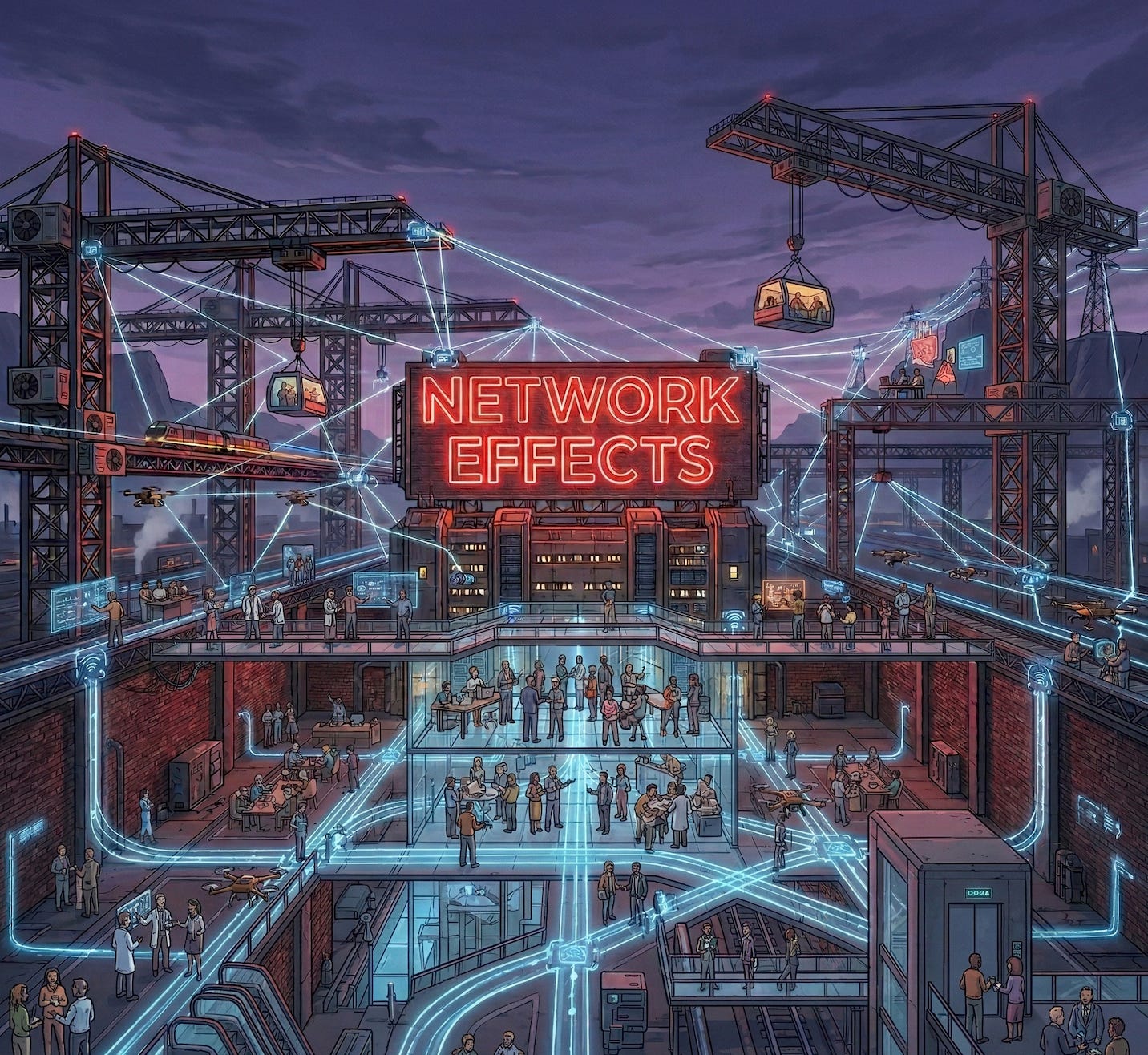
When a product launches it attracts initial users. If the product is popular, more people flood to use it, making it even more popular. As it grows in popularity and user numbers, more people begin to use the product until it reaches a tipping point of no return. This self-reinforcing feedback loop is the power of Network Economies.
This phenomenon is behind the explosion of companies like Meta (Facebook), Uber, LinkedIn and TikTok. Meta and TikTok become more valuable as people use the apps to communicate and share their lives with friends and family. LinkedIn becomes more valuable as more professionals join the network, meaning you no longer have to physically go out to network. As more people use Uber, more drivers join, and the days of queuing up in the rain at a taxi rank are over.
Not only do they create more value as they become ever more popular, but they also become increasingly difficult to move away from as user count increases.
If Scale Economies is math: Network Economies is psychology.
This is the third piece in the 7 Powers series — a deep-dive into Hamilton Helmer's framework for understanding how businesses build durable competitive advantage. If you're new to the series, the introductory piece explains why value creation alone isn't a moat, and the second piece on Scale Economies uses TSMC and Intel to show how cost structures become competitive weapons. This piece covers the second Power: Network Economies.
What Are Network Economies?
Let’s first define what Network Economies are:
A business in which the value realised by a customer increases as the installed base increases. — Hamilton Helmer
I was listening to an Acquired1 episode on Meta this week in preparation for this article and was blown away by a fact. Meta has 4 billion users (of which 3.5 billion are active daily users) across Facebook, Instagram, Messenger and WhatsApp. That’s nearly half of the world’s population. TikTok has an estimated 1.5–2 billion active daily users and LinkedIn roughly 1 billion. These apps have become part of people’s routines, and to a certain extent—their lives.
I remember when WhatsApp first came out. I had some friends who used iMessage to communicate and others through BlackBerry. WhatsApp came along and created an ecosystem where it didn’t matter what type of phone you had, because you all used the same messaging platform. It became very sticky. And that was the point. WhatsApp with some friends using it was mehh, but WhatsApp with all of your friends was everything. Especially as a teen.
Now think about professional networking. There’s nothing wrong with meeting up for a coffee, or going for a few social drinks (i’m quite partial myself), but professionals are busy people. LinkedIn looked to solve the problem of people wanting to network more, but struggling to balance their professional and personal lives, by creating a professional networking platform available 24 hours a day, 365 days of the year. Of course, there’s nothing they can do about some of the utter cringe people put on there. Perhaps it adds to its appeal.
The key difference between Network Economies and Scale Economies is this: unlike Scale Economies, where your costs come down from having volume—in Network Economies the value of your product increases from having volume. By volume I don’t just mean having lots of customers—that’s market share. The volume of people using a product must materially increase its perceived value to existing users.
Types of Network Effects
Direct Network Effects
Social media has direct Network Effects: more users = increased value for existing users. Skype had this too. Just like WhatsApp, it was useless unless the person you wanted to reach had it. Going analogue, when Alexander Bell’s telephone patent expired in 1894, hundreds of independent companies launched as the craze for telephones was booming. AT&T’s response was to refuse the independent companies interconnection—if you weren’t on their network, you couldn’t call their customers. Their network was more valuable because they could reach more customers.
Currency and language are two of the oldest Network Effects you can think of. The dollar (or Bitcoin) has zero utility as a standalone item unless people adopt it and actively trade with it. Remember—before currency, people traded silver, gold, bread, camels and daughters! Much to my dismay (as i’d love to learn a new language), the world has adopted the English language as its preferred second language. The more people speak English, the more people from non-English speaking countries want to learn it. It doesn’t matter that there are more Indian and Chinese speakers than there are English.
Indirect Network Effects
Black cabs used to rule the roost in the UK. If you wanted a taxi in central Manchester or London, you’d do well to find a cab that wasn’t a black cab. Enter Uber. The more drivers Uber put on the road, the more people used their app. The more people used their app, the more drivers signed up to taxi for Uber. This is indirect Network Effects, or two-sided platforms. It works the same way with eBay. eBay on its own wouldn’t be much use to anyone, but the more people that list stuff on eBay, the more people buy. Once eBay becomes more popular, even more people want to sell stuff on eBay, encouraging even more people to buy.
Amazon created this feedback loop through FBA (Fulfilled by Amazon), except it has a triple benefit: the seller, the buyer and Amazon. Win-win-win.
Value comes from at least two different groups benefitting each other.
Data Network Effects
Tesla states on their website that their Full Self-Driving2 cars have been trained on “over 100 years of anonymous real-world driving scenarios” from a fleet of over six million vehicles, and that the fleet “collectively experiences a lifetime of driving scenarios in 10 minutes.”. By mid-2025, Tesla’s fleet was reportedly adding around 15 million miles a day. Although Google is currently leading the way on fully autonomous cars, this amount of data collection from Tesla is staggering. Musk said himself that this data had increased AI training compute by 400% in 2024 alone. This data is used to produce better products for Tesla and train their AI.
Platform Network Effects
Through the iPhone, Apple created one of the best examples of Platform Network Effects: iOS. Apple’s apps alone are powerful—having an iPhone is like having a little computer that fits in your pocket—but throw in Apple’s App Store, which opens it up to third-party developers, and you have the world at your fingertips. The value isn’t created from individually having an iPhone, but from third-party developers offering the user roughly 2 million apps.
Other examples include: Obsidian allowing third-party developers to create community plug-ins, Shopify’s app store, Amazon AWS, and Visa by connecting cardholders with merchants.
Hybrid
The truth is many companies have multiple types of Network Effects: Apple, Amazon, Uber. The apps or products they create serve more than one person or group, their perceived value increases as more people use them, and they all collect swathes of data that they use to create even better products.
Benefits & Barriers
The Benefit
The benefit of Network Effects is clear: the value of a product increases as more people adopt it. The sheer scale of audience capture can lead to rapid growth, increased popularity (further increasing audience), and outside investment. Companies that are in a leadership position with Network Economies can charge higher prices than those whose products are perceived to offer less value, because audience volume is substantially less.
The Barrier
Competing with a company that has genuine Network Effects can be costly. The cost of gaining market share (customers) can have a substantial negative impact on the opponent’s P&L as they battle to incentivise people to defect to their product. But nobody likes to arrive at an empty party. For developers, this means they need to create a space that will attract the most people in the quickest amount of time—but reputable socialites always arrive late, when the house is full. The platform you’re reading this on has done a pretty good job at convincing big household names to move onto the platform in the last 12 months. This makes Substack even more appealing, which in turn will bring in even more household names. Most companies create benefits—but barriers are what create long-term differential returns.
Companies that have true Network Effects often exhibit winner-take-all scenarios, and competition has two options: 1) fight (and probably lose), or 2) create something novel.
Some barriers may look like genuine Network Effects, but features aren’t a barrier. At least not a durable one. When Snapchat came along with their novel feature “stories”, people loved it. Who’d have thought it, aye. But creating timed disposable videos isn’t a sustainable moat, and for Snapchat the water dried out—when Facebook had enough data to validate the idea, they copied them. So did Instagram (owned by Meta). People still use Snapchat (just Snap now), but their novel idea wasn’t structural—it was too easy for a competitor to rob their idea for their superior network to benefit from. Companies can also match your pricing, but if they don’t have the volume those profits will take a battering unless they have a substantial cost-saving benefit—or scale advantage.
The astute business strategist knows to look for the barrier conditions first—why can’t customers leave this network, not why did they join in the first place.
Case Study: Meta’s Dominance
Network Effects are perhaps the most potent of Helmer’s 7 Powers, but many strategists miss one critical distinction: Network Effects do not automatically constitute Power. For there to be genuine Power there must be durable differential returns and immunity from competitive onslaught. Meta Platforms unconditionally demonstrates Helmer’s conditions for Power.
Mark Zuckerberg launched “TheFacebook” from a Harvard dorm room on 4th February 2004, and within 24 hours, 1,200 people had joined. Initially limited to .edu emails, Zuckerberg paired exclusivity with intoxicating FOMO effects, and within a month over half of Harvard’s undergrads were on the platform. Facebook reached 1 million users by the end of 2004, 100 million by 2008, and crossed 1 billion monthly active users in October 2012—making it the first social media platform to do so. Meta’s sheer reach defies comprehension: 43% of the world’s population use Facebook, Instagram, WhatsApp, Messenger or Threads daily, and 48% monthly. Facebook alone has 2.1 billion active daily users, with a 60% daily retention rate. These numbers mean that nearly every other human being you see on Earth uses one of their products each month.
The company’s market cap has grown from $81.7 billion at its 2012 IPO to $1.66 trillion as of writing, representing a compound annual growth rate of roughly 24%. This includes a 76% peak-to-trough decline in 2021–2022, driven by metaverse spending concerns, Apple’s App Tracking Transparency hit, and TikTok competition. Let’s not forget the Cambridge Analytica scandal in 2019 either. Zuckerberg trimmed the company by cutting 21,000 jobs to refocus on AI, and from the trough in October 2022 the stock would rebound over 500% (it would later come down again due to capital expenditure fears).
A £10,000 investment in Facebook on the day of its IPO would be worth roughly £170,000 today.
The Failed Challengers
Facebook has boxed many a round with challengers including: Google+, Snapchat, MySpace, Ello, Peach, Vero, Diaspora, Path and Friendster. How was Facebook able to fight off these companies—especially Google, with its billions of capital and users already integrated into its ecosystem? Because Facebook had genuine Network Effects. These companies may have had a product that users would benefit from if they switched—but they never figured out why users would want to leave: the barrier.
TikTok represents the most sincere competitive threat to Facebook, as they pivoted to a different network: teenagers—who weren’t yet embedded in Facebook.
People regularly complain about the Meta ecosystem saying they want to leave, but the numbers don’t show that. User numbers are increasing year on year. Facebook has had numerous scandals: Cambridge Analytica, data breaches, privacy violations, content moderation failures, mental health concerns, antitrust investigations. Any one of these would sink most companies. Yet last year advertising revenue increased 22.1% to $196.2 billion, accounting for nearly 98% of total revenue.
Saying you want to leave is one thing, but not being able to because you’ll lose access to your network is textbook Network Economies.
Meta has compounded its revenue at 27% a year for the last 10 years. They consistently carry gross margins of 80%+ and have left a graveyard of competitors in their wake. You’ve seen how Facebook built the world’s largest social network. But here’s what separates Network Economies from every other Power: your customers become each other’s switching costs.
In the complete essay, you’ll discover:
Why Google couldn’t beat Facebook: Despite superior technology, unlimited capital, and Google’s distribution power, Google+ failed catastrophically. The barrier wasn’t technical—it was structural.
The Three-Question Diagnostic: Determine if network effects are strengthening or weakening—critical for investment analysis
When networks collapse: The specific conditions under which network effects reverse and platforms die (MySpace, and what nearly killed Facebook)
Five Red Flags: Red flags to watch out for when analysing companies that might show structurally weak Network Effects
Subscribe to The School of Knowledge+ to get the complete framework for identifying and analysing Network Economies—the Power where growth itself becomes the barrier. For this series I am offering a lifetime 20% discount for those who join:
